Author: Hyundai Heat Pump
Published on: 2 November 2026
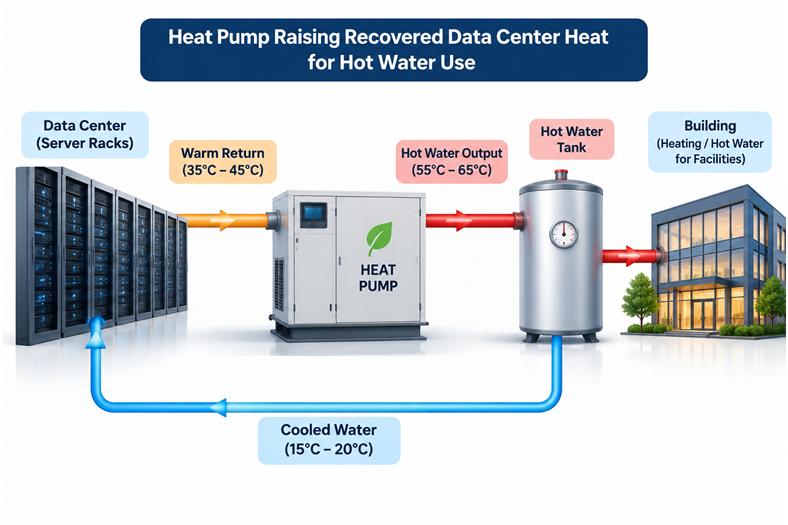
A heat pump for data centers raises the temperature of heat your cooling system already removes. Instead of rejecting that heat through cooling towers or dry coolers, you can reuse it for hot water or heating. This guide explains how it works, what decides feasibility, and what to prepare before an assessment.
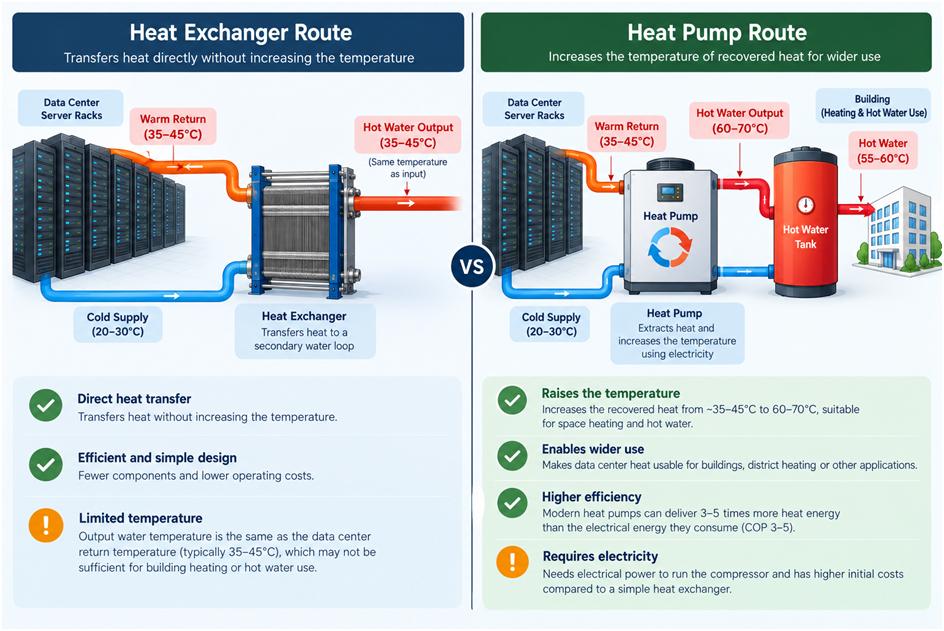
Data center waste heat recovery means capturing the heat that servers release and putting it to use. Almost all the electricity a server consumes ends up as heat, and cooling systems carry it away. Normally that heat is released outdoors. In a recovery system, a heat exchanger or heat pump takes it from the cooling loop and delivers it to a building, a hot water system or a process. The result is less wasted energy and, in some designs, less load on cooling towers.
The main obstacle is temperature. Heat from air-cooled facilities is usually low grade, meaning too cool for most heating uses. A heat exchanger alone cannot make cool water hotter than its source. Liquid-cooled systems return warmer water, and research on high-performance computing has measured recovered water in the 30 °C to 38 °C range, with some liquid-cooled designs reaching higher. Even then, hot water for buildings is typically needed at a higher temperature. That gap is why a heat pump enters the design.
A heat pump moves heat from a cooler source to a warmer destination, using electricity to drive a refrigerant cycle. If you want the basics, Hyundai explains how a heat pump works in plain terms. In a data center, the source is the warm water or air leaving the cooling system. The heat pump takes that heat and lifts it to a useful temperature. One operator described it as a reverse refrigerator. It draws heat from the cooling loop, then compresses the refrigerant to raise its temperature before the heat goes to the user. A side benefit is that the cooling loop returns cooler water to the servers.
Four factors decide it. Each one can make or break the business case.
An industry report from June 2026 made the same point: the closer the source temperature is to the delivery temperature, the less electricity the heat pump needs to close the gap. It also noted that the shift toward direct liquid cooling is raising waste heat temperatures, which improves the economics.
Space heating demand in most of India is limited, so reuse projects here usually look different from Nordic district heating. Likely uses are domestic hot water for canteens, hostels and staff facilities, laundry, and nearby commercial or hospital buildings with year-round hot water demand. Process heat for suitable industries is another option. Because a data center runs all year, a user with continuous demand matters more than a seasonal one.
If the demand is a large, steady hot water load, read how commercial heat pump water heaters differ from domestic ones before sizing. Always size the project around real heat demand, not just the heat available.
| Factor | Heat exchanger only | Heat pump |
|---|---|---|
| Works when source is cooler than needed | No | Yes |
| Electricity use | Low | Higher, to lift temperature |
| Best source | Warm liquid-cooled return | Cooler air or water loops |
| Typical use | Low-temperature heating | Hot water and higher-temperature heating |
If your recovered heat is already close to the temperature you need, a heat exchanger may be enough and cheaper. Where it falls short, a heat pump closes the gap. Some research designs combine the two, using a small heat pump to support an exchanger. The right choice depends on the numbers for your site.
Hyundai heat pumps are supplied in India by Purever, the authorised distributor. For larger hot water loads, the RS Series commercial heat pump water heater is listed from 18 kW to 192 kW, with up to 16 units cascaded, hot water output up to 60 °C, and MODBUS RS-485 for building management systems. Smaller loads can look at the R32 air-to-water heat pump range.
One point matters for data centers. These are air-source designs that draw heat from outdoor air. They suit the hot water side of a facility, but they do not recover heat from a server cooling loop on their own. A water-source arrangement is a different configuration, so confirm source-side compatibility with Hyundai's team before assuming a fit.
A feasibility review is quicker and more accurate with the right inputs. Gather these before you contact a supplier:
With these details, an engineer can estimate how much heat is recoverable, what temperature lift is needed, and whether the project is worth pursuing.
More general questions are answered on the heat pump FAQs page.
Q: Can a heat pump recover heat from a data center? Yes. It takes heat from the cooling loop and lifts it to a higher temperature for hot water or heating.
Q: Is a heat pump always needed for data center heat reuse? No. If recovered heat is already hot enough, a heat exchanger may do the job. A heat pump is needed when the temperature must rise.
Q: Does liquid cooling make heat recovery easier? Generally, yes. Liquid-cooled systems return warmer water, which reduces the temperature lift the heat pump must provide.
Q: What limits heat reuse the most? Having a nearby user with steady demand. Available heat alone does not make a project viable.
Waste heat from servers can become a useful energy source when the temperature, cooling design and heat demand line up. A short feasibility review will show whether your facility is a good candidate.
To begin, request a heat pump feasibility assessment with your cooling setup, expected recoverable load and nearby heat demand.
No related articles found.
Heat Pump for Car Wash Businesses: Hot Water and Operating Costs
28 October 2026
Heat Pump for Commercial Laundry: Planning Hot Water Capacity and Demand
28 October 2026

Heat Pump BMS Integration: A Smarter Approach to Commercial Heating Control
16 October 2026

Heat Pump for Food Processing Industry: Where Heat Recovery Can Improve Plant Efficiency
16 October 2026
Heat Pump for Textile Industry: Opportunities for Heat Recovery in Textile Manufacturing
29 September 2026
Heat Pump for Apartments: How to Plan an Efficient Centralized Hot Water System
24 September 2026
No related articles found.