Author: Hyundai Heat Pump
Published on: 10 September 2026
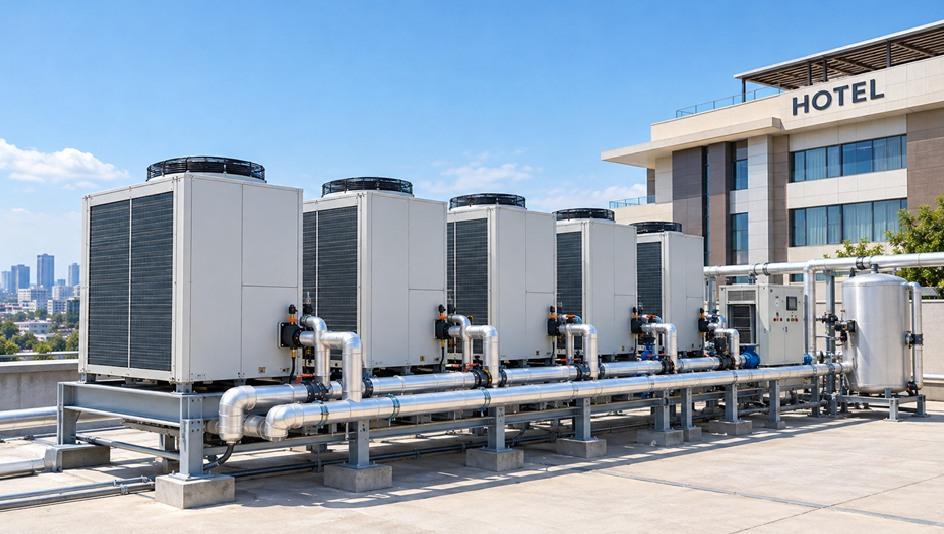
A heat pump for hotels cuts hot water energy costs sharply — without guests ever noticing a change in supply.
Hot water never really stops in a hotel. Guests shower before an early checkout, kitchens run all day, and laundry keeps cycling through the night. That nonstop demand makes water heating one of the biggest controllable costs on a property's electricity bill.
This guide covers real running-cost numbers, sizing, and what to check before installation.
A heat pump for hotels moves heat from outside air into stored water instead of generating heat directly. One unit of electricity in a heat pump typically delivers three to four units of heat output, unlike a diesel boiler or electric geyser that converts energy close to one-to-one. That difference is why hotels running large volumes of hot water see the fastest payback.
Diesel and LPG boilers burn fuel continuously, and fuel prices swing with the market. Electric geysers heat water directly, which is simple but expensive at hotel-scale volumes. A commercial heat pump borrows most of its energy from the air instead.
Fuel type decides the ceiling on running costs. Everything below builds on that one choice.
Diesel-fired water heating typically costs a hotel roughly ₹7 to ₹10 per kWh of delivered heat, while a commercial heat pump delivers the same heat for approximately ₹2.5 to ₹3 per kWh. That gap usually works out to a 65–75% reduction in water heating energy costs, with payback commonly achieved within two years for a busy property.
The savings are not a marketing estimate — they follow directly from how each system uses energy. A boiler pays for every unit of heat it makes. A heat pump pays only for the electricity that moves heat already present in the air.
The Bureau of Energy Efficiency has found that Indian hotels can cut 20–30% of total energy use through efficiency upgrades like this, without lowering guest service standards. (Source: BEE India hotel energy guidebook)
Sizing depends on peak-hour demand, not average daily use. As a working benchmark, a 100-room hotel typically needs 60–80kW of heating capacity, achieved with four to five 18kW units running in a cascaded, lead-lag configuration, plus a buffer tank for surge protection.
Every hotel has a rush — usually early morning checkouts or evening turnover. Size for that window, not for a quiet Tuesday afternoon, or guests will hit cold water exactly when it matters most.
Get the peak number right once, and the rest of the sizing decision follows naturally.
No. A correctly sized commercial system delivers hot water at a consistent temperature — up to 60°C — across every outlet at once, so early risers and late checkouts get the same experience. Cascade control brings extra units online automatically as demand rises, instead of one unit straining alone.
Comfort complaints usually trace back to undersized or single-unit systems, not the technology itself. A cascaded setup with a buffer tank avoids both cold surprises and wasted standby heat.
Guest comfort is really a sizing and controls question — the heat pump itself just needs to be specified correctly from day one.
| Feature | Diesel Boiler | Electric Geyser | Commercial Heat Pump |
|---|---|---|---|
| Approx. cost per kWh delivered | ₹7–10 | High (resistance heating) | ₹2.5–3 |
| Fuel dependency | High — needs diesel supply | None | None — electricity only |
| Typical payback vs upgrade | N/A (baseline) | N/A (baseline) | Around 2 years |
| Ambient operating range | Not weather-dependent | Not weather-dependent | -15°C to 43°C |
| Best for | Legacy sites, no grid limits | Small guesthouses | Hotels, hospitals, gyms |
Diesel and resistance geysers set the baseline most hotels are trying to move away from. A commercial heat pump is built specifically to replace both at hotel scale.
Yes. Commercial units are rated from -15°C to 43°C ambient temperature, so the same system works for a resort in Shimla and a business hotel in Hyderabad. Auto-defrost logic protects winter performance, and the compressor does not derate during peak summer heat.
Many imported systems are designed around milder European climates and struggle above 40°C. A unit engineered for Indian conditions needs to hold output through both a Delhi summer and a hill-station winter.
Climate range matters more for hotels than most buildings, since even one wing without hot water becomes a guest complaint fast.
Confirm three-phase power availability, plant room or rooftop ventilation, and minimum water flow rate before ordering. Most commercial installations are completed by standard plumbers or HVAC installers, since the refrigerant stays sealed inside the outdoor unit.
Q: How much can a hotel realistically save by switching to a heat pump for hot water? Most properties see a 65–75% drop in water heating energy costs compared with diesel or LPG boilers, with payback typically inside two years, depending on occupancy and current fuel costs.
Q: Can a heat pump handle a 100-room hotel's morning rush? Yes, with correct sizing. A 100-room property typically needs 60–80kW across four to five cascaded units, plus a buffer tank to absorb the simultaneous morning surge.
Q: Do hotel heat pumps work in hill station properties with cold winters? Yes. Commercial units are rated down to -15°C ambient with automatic defrost, so hill-station resorts and plains properties can run the same system type.
Q: Will a heat pump disturb guests if installed near rooms? Properly engineered commercial units run quietly enough for rooftop or terrace placement near occupied floors, though standard clearance and placement guidance should still be followed.
Q: Does switching to a heat pump require a gas connection? No. Heat pumps run entirely on electricity, removing the need for gas lines, flue pipes, or on-site fuel storage.
Q: Can an existing hotel retrofit a heat pump without a full renovation? Yes, in most cases. Because the refrigerant stays sealed in the outdoor unit, installation mainly involves water-side connections, making phased retrofits practical for operating hotels.
Cutting a hotel's hot water energy bill comes down to three decisions: the right capacity for peak demand, a system built for Indian ambient extremes, and a fuel switch away from diesel or resistance heating. Get those right, and guests get the same reliable hot water while the property spends far less to deliver it.
Ready to size the right system for your property? Talk to a Hyundai heat pump specialist for a capacity assessment matched to your hotel's room count and peak demand.
No related articles found.
Heat Pump for Hospitals: A Guide to Reliable and Energy-Efficient Hot Water Systems
11 September 2026
Heat Pump Maintenance Guide: How to Keep Your System Efficient and Reliable
02 September 2026
Heat Pump Water Heater for Home: How to Choose the Right System for Your Household
02 September 2026
Heat Pump Water Heater Installation: Requirements, Process and Key Considerations
02 September 2026

Dehumidifier vs Air Conditioner: Which Is Right for You?
24 July 2026
What Are Industrial Heat Pumps and How They Work
24 July 2026
No related articles found.